Incoterms
Introduction
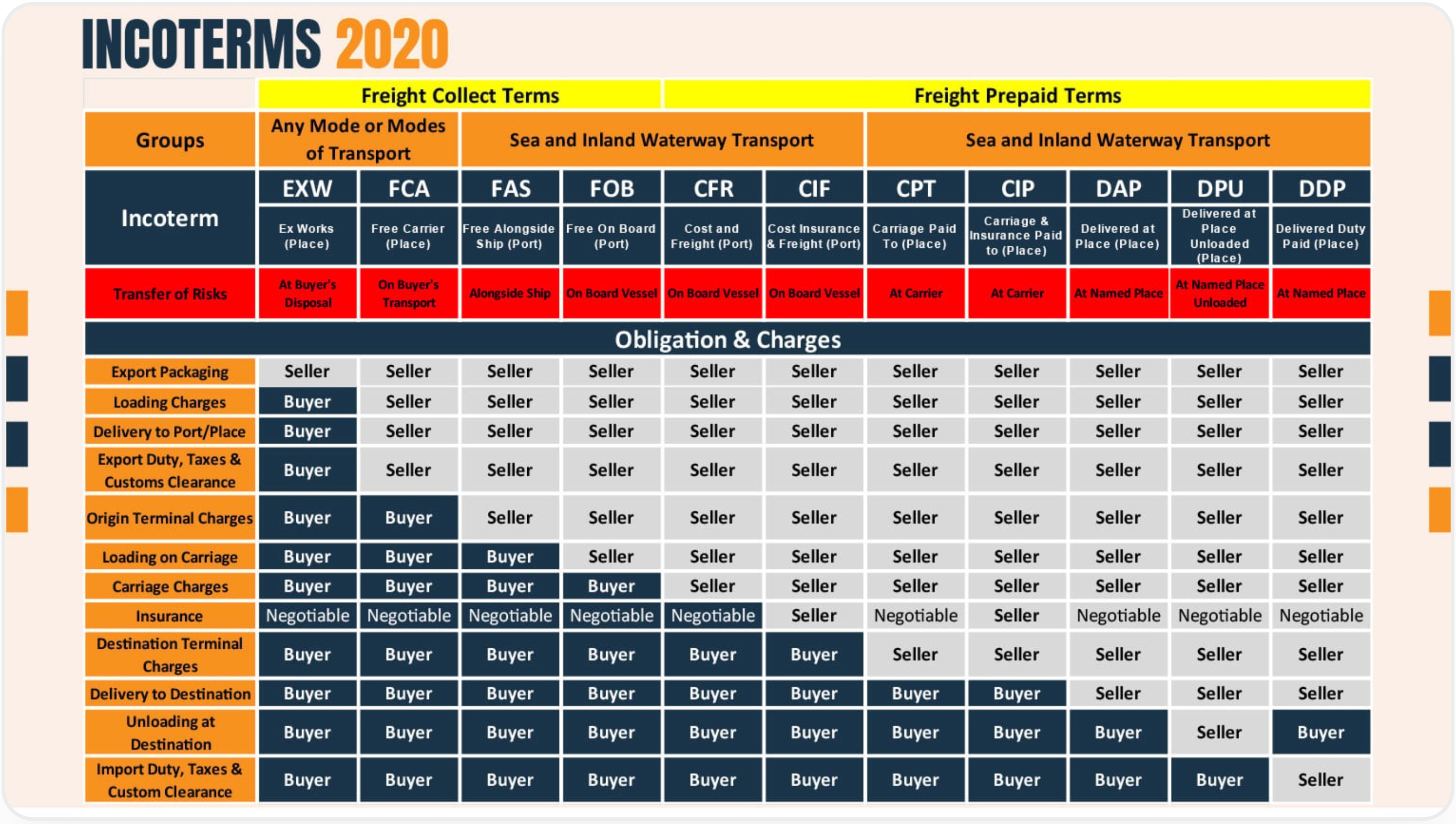
Incoterms (International Commercial Terms) are a set of 11 standardized rules by the International Chamber of Commerce (ICC) that define responsibilities for buyers and sellers in international trade, clarifying who pays for shipping, manages transport, secures goods, handles customs, and when risks transfer from seller to buyer. These three-letter codes (e.g., EXW, FOB, DDP) simplify contracts, ensuring clear allocation of costs, risks, and duties for smooth global transactions, with the current version being Incoterms 2020.
What they define
• Costs: Who pays for freight, insurance, duties, and other logistics.
• Risks: Where and when the risk of loss or damage to goods shifts from seller to buyer.
• Responsibilities: Who manages transport, insurance, documentation, and customs clearance.
Types of Incoterms (Incoterms 2020)
For Any Mode/Modes of Transport (7 terms): Applicable to all transport types (road, rail, air, sea).
• EXW (Ex Works): Seller delivers goods at their premises; buyer takes most risk/cost.
• FCA (Free Carrier): Seller delivers to carrier nominated by buyer.
• CPT (Carriage Paid To): Seller pays for carriage to destination, but risk transfers earlier.
• CIP (Carriage and Insurance Paid to): Similar to CPT, but seller also arranges insurance.
• DAP (Delivered at Place): Seller delivers to a named place, ready for unloading.
• DPU (Delivered at Place Unloaded): Seller delivers and unloads at the destination.
• DDP (Delivered Duty Paid): Seller bears all costs/risks to destination, cleared for import.
For Sea & Inland Waterway Transport (4 terms): Specific to water transport.
• FAS (Free Alongside Ship): Seller places goods alongside the vessel.
• FOB (Free on Board): Seller delivers goods onto the vessel nominated by buyer.
• CFR (Cost and Freight): Seller pays cost/freight to destination port.
• CIF (Cost, Insurance, and Freight): Seller pays cost, insurance, and freight to destination port.